What a mouse study can tell us about music, pain, and the brain
By Jonetta Fredreana Harrison, Graduate Student in Strategic Media | AudioAnalgesiA Research Network
I’ll start by saying I’m not a science person. I do love research, though, so when I got to interview Dr. Stephen Boehm about the AudioAnalgesiA pilot study, I was excited to learn something new. I learned a lot more than I expected.
The first thing Dr. Boehm told me is that he isn’t a pain researcher. “I’m not a pain guy,” he said. He is an addiction neuroscientist. For about 20 years his work has centered on binge drinking in mice and how it changes the brain and behavior, especially the circuits involved in decision making and reward. He started modeling binge drinking in mice back in 2005. These days his lab also studies opioid use disorder, psychedelics, cannabis, and weight loss drugs like tirzepatide, and how they affect substance use.
So how does someone with that background end up working on music and pain?
He started out as a music major
The answer goes back to college. Dr. Boehm was a music major for a couple of years, then he switched his major.
Around that time he took a class with Dr. David Gilliam, a behavioral geneticist, who asked if he wanted to get involved in research. Dr. Boehm said he hadn’t been thinking about that, but he had always liked his science classes, so he gave it a try. In Dr. Gilliam’s lab he got to run a project from beginning to end on what was then called fetal alcohol syndrome, which is now called fetal alcohol spectrum disorder. The question was whether an embryo’s genotype affects how sensitive it is to binge alcohol exposure during pregnancy. It does, and Dr. Boehm described that paper as a foundational one in his field. It sent him to graduate school in Portland, Oregon, and he has used mice to study alcohol ever since.
How music came back
Music came back into his work through Dr. Debra Burns. Dr. Boehm met her in Indianapolis, where she was a faculty member and department chair. She recruited him to this project because she knew he could model many kinds of behavior in mice, and that if he didn’t know how to do something, he would figure it out. Dr. Burns has since moved to the University of Memphis, and he told me he’s happy for her.
He said the idea of doing behavioral neuroscience that involved music was fascinating to him. It was something he had always thought about but had never worked on.
What the pilot study is trying to find out
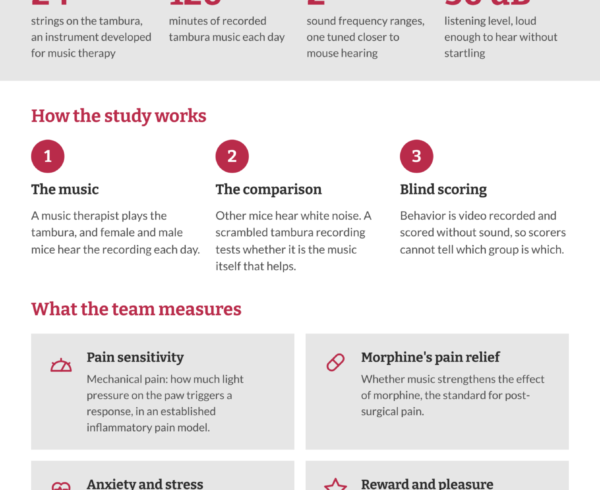
The study asks whether music can reduce pain sensitivity in mice. Dr. Boehm’s team is modeling chronic mechanical pain, which they think may line up better with what someone with chronic pain, like a person dealing with cancer, might experience.
Because he’s an addiction researcher, he also has a second question. Could music help lower the amount of opioid needed to get the same pain relief? “Can we use a lower dose of the opiate and along with the music, achieve the same therapeutic effect?” he asked. His team has some data suggesting it might, but he was clear that they’re still working on it. “This is harder than you think.”
Part of what makes it hard is that music is tough to control. With an injected drug, he can set the dose, the timing, and how it’s given. With music, the mice are just hearing it. How loud should it be? What kind of music? He pointed out that even a favorite song gets unpleasant if someone turns it up too loud. And these mice have never heard music before.
So another part of the pilot study checks whether the music is stressful for them at all. The team measures corticosterone, which is the mouse version of the stress hormone cortisol. They want to know if the music causes a stress response, and if it can lower one when the mice are put in a stressful situation. Dr. Boehm said they think they have the loudness range figured out.
Why mice?
I asked what readers might find surprising about his lab. He said a lot of people don’t realize how much a mouse can tell us about people. Adolescent mice act a lot like human adolescents, with more impulsivity and risk-taking. Mouse and human brains have the same basic parts, and the main difference is how thick the cortex is. There’s a lot of genetic overlap too, and genes found to matter in rodents have often turned out to matter in humans.
He doesn’t oversell it. A treatment that works in a mouse won’t automatically work in a person, and he said the field is less sure about some measures, like depression-like behavior. But he’s optimistic.
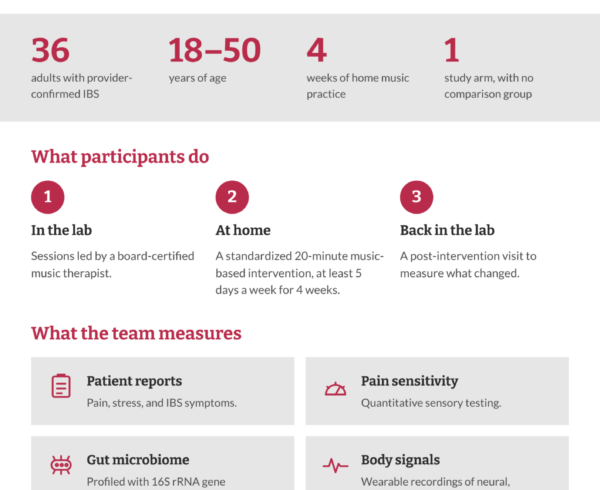
I also asked the question that popped into my head near the end: when would this move to human trials? He said trials of music in people are already happening. What the mouse study adds is the “how.” Clinical data already shows music has some therapeutic value, so “it’s not about whether it works in the human or not. It’s about how is it working.” In mice he can do things he can’t do in people, like turning off a specific brain circuit to see what happens to pain processing. If the team finds a brain mechanism, even a small hint of one, they can take it back to human researchers and design a brain imaging study to look for the same thing. He even floated the idea that someday the effect might be reproduced without music at all.
Taking care of the animals
Dr. Boehm brought up animal care himself. Pain research is part of why he’s new to this area, and he said it makes him a little squeamish. “I just told you that we don’t want to make a mouse suffer. And now we’re talking about how you model pain in the mouse. That is not lost on me. I don’t like it.”
He said his lab goes through a lot of steps so the mice don’t suffer unnecessarily. He added that even if someone doesn’t care about that, a suffering mouse won’t give you good data.
For people living with chronic pain
When I asked what he’d want someone living with chronic pain to take from this, he went back to the mouse. The point of this work isn’t to prove music helps, because there’s already good clinical data that it does. The point is to understand how, and the mouse lets researchers study the brain in ways they can’t in people. That understanding could one day mean better options for people who are dealing with chronic pain.
Stephen L. Boehm, PhD, is Professor of Psychology at Indiana University Indianapolis and Executive Director of the IU Institute for Human Health and Wellbeing. He is a behavioral neuroscientist working with the AudioAnalgesiA Research Network. This interview was conducted on November 11, 2026.