audioanalgesiaaudioanalgesiaaudioanalgesiaaudioanalgesia
  • About
  • Team
  • Research
  • Pilot Funding
  • Publications
  • News
  • Join Our Network

The science of how music relieves pain, modeled and measured.

We bring together music therapy, neuroscience, data science, and engineering to build the computational models, AI tools, and technologies that explain how and why music helps people manage pain.

Join Our NetworkExplore the Research Roadmap

Our mission is to form a transdisciplinary group of clinicians, musicians, researchers, and people with lived experience to identify and investigate the mechanisms that explain how music-based interventions improve pain-related outcomes.

audioanalgesia is a collaborative research network funded by the National Center for Complementary & Integrative Health of the National Institutes of Health (NCCIH) and the National Endowment for the Arts (NEA) under Award Number U24AT012602.

Find Your Way In

Engineers and Data Scientists

Bring signal processing, machine learning, and sensing expertise to an open problem in health. Find publications, methods, and collaborators across the network.

See the research roadmap

Clinicians and Music Therapists

Connect clinical questions to mechanism research, and see how network findings can inform music-based care for people living with pain.

Read our publications

Students and Early-Career Researchers

Take part in webinars and working groups, and watch for future pilot funding designed to help new investigators build toward larger studies.

Join for updates

Research Roadmap

From knowing that music helps to understanding how. Our work follows three phases, moving from explanation toward music-based interventions that adapt to each person.

Phase 1

Explainable AI

Models that show which features of music, and of the listener, drive changes in pain, so findings can be tested and trusted.

Phase 2

Real-Time Adaptive Systems

Wearables and digital biomarkers that sense a person’s response and adjust the music as it plays.

Phase 3

Multimodal Integration

Brain imaging, physiology, and molecular data combined into one picture of how music acts on pain.

Pilot Funding

Program

Pilot Research Program

The network funds small-scale, high-risk and high-reward pilot projects on mechanisms and innovative measurement in music-based pain research.

The 2025-2027 call for applications has closed. Future funding opportunities will be announced here and to network members.

Join Our Network for Updates

Learn about the pilot program

Research

Funded Pilot Projects

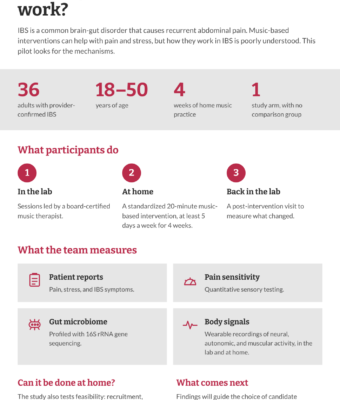
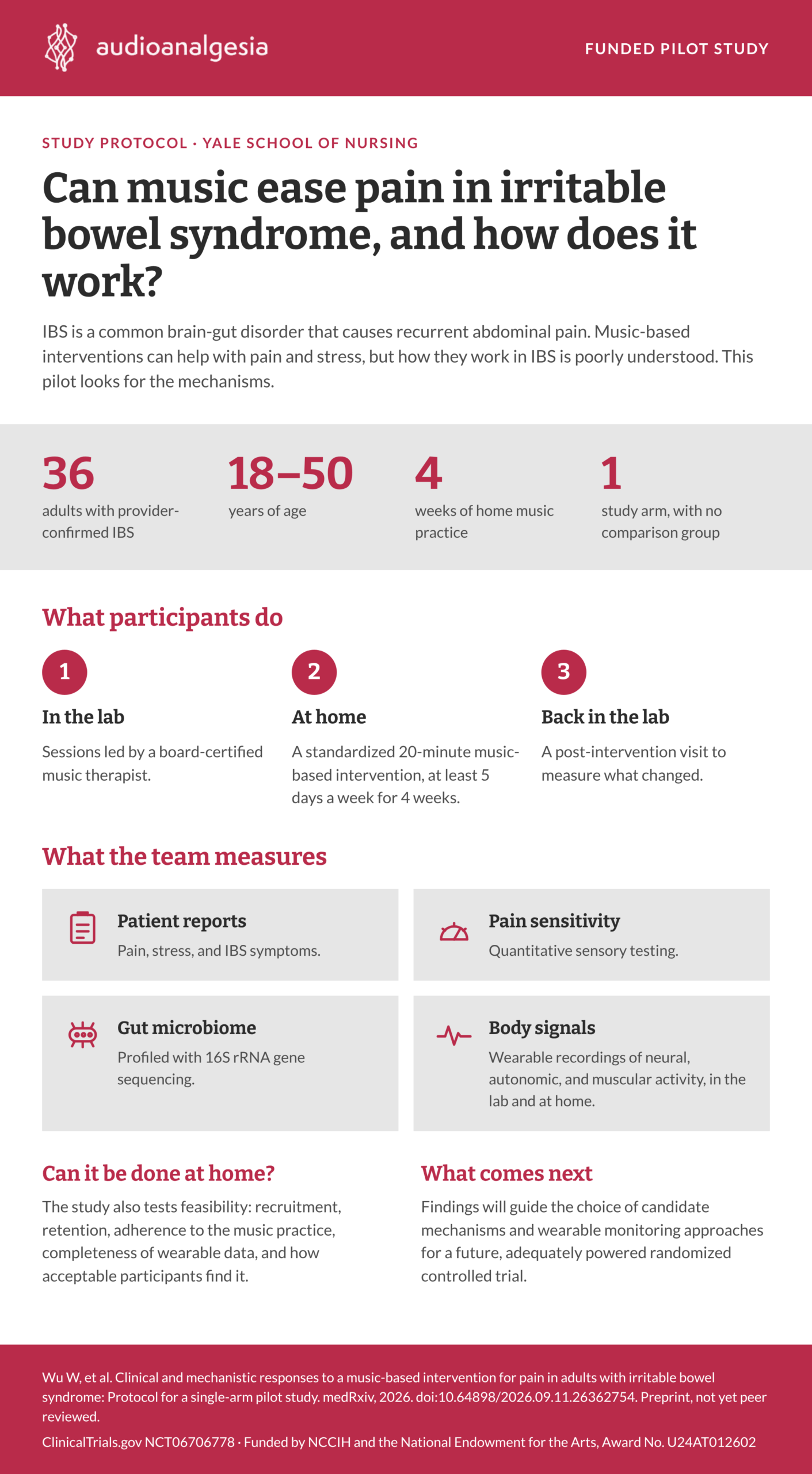
Infographic summarizing the AudioAnalgesiA-funded pilot study of a music-based intervention for pain in adults with irritable bowel syndromeMusic for pain in adults with irritable bowel syndromeYale School of NursingRead the protocol

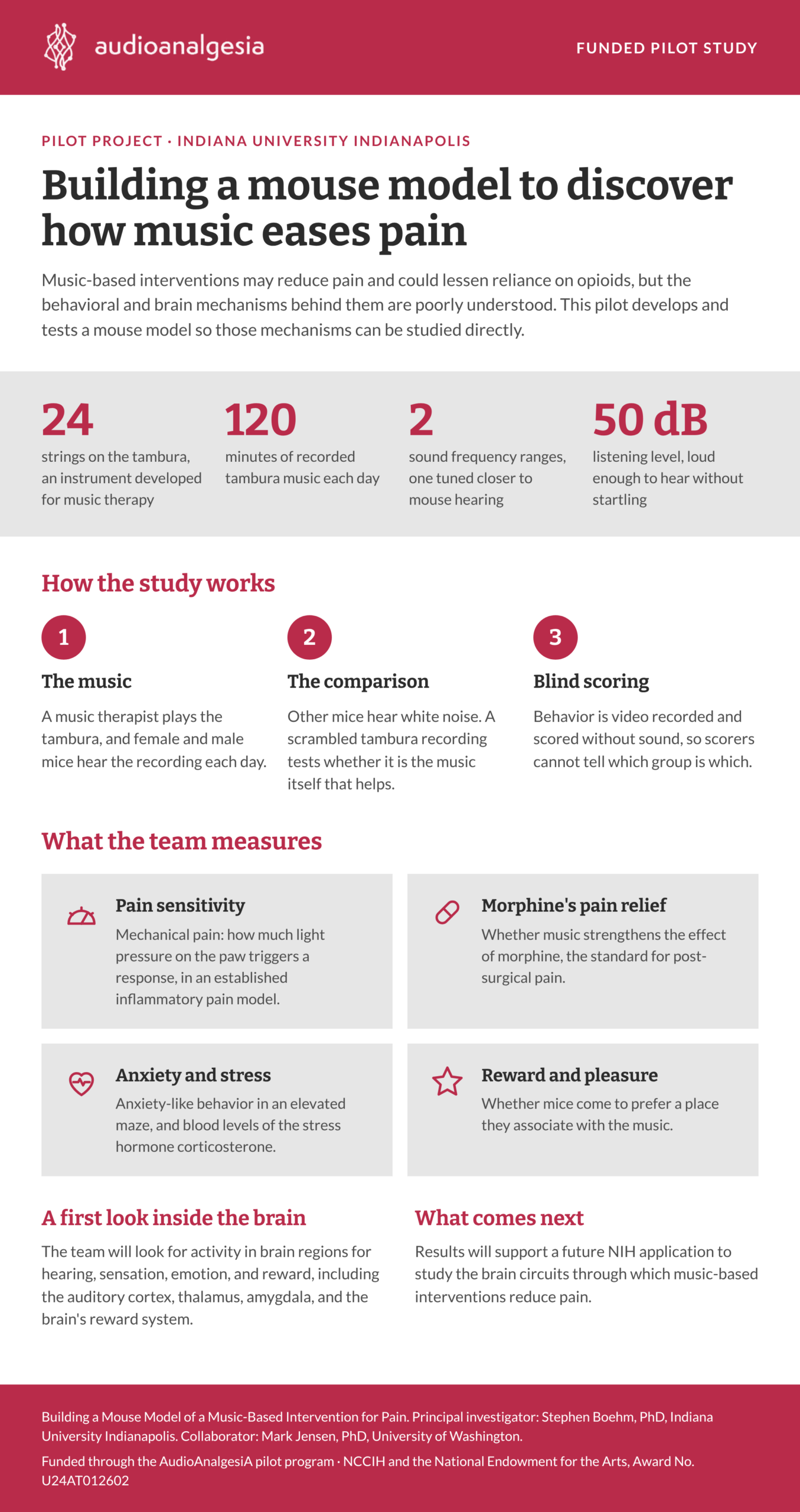
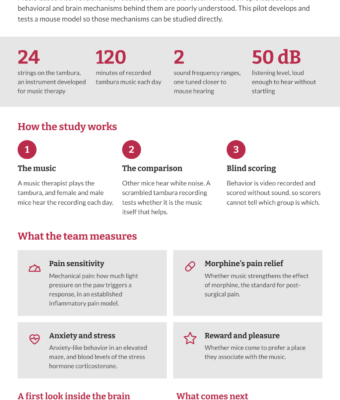
Infographic summarizing the AudioAnalgesiA-funded pilot study building a mouse model of a tambura music-based intervention for painBuilding a mouse model of a music-based intervention for painIndiana University IndianapolisView the infographic

See all funded projects

News

Infographic summarizing the AudioAnalgesiA-funded pilot study building a mouse model of a tambura music-based intervention for pain

Funded pilot study: building a mouse model of music for pain

10 November 2026
Comments are Closed
News
Infographic summarizing the AudioAnalgesiA-funded pilot study of a music-based intervention for pain in adults with irritable bowel syndrome

Funded pilot study: music for pain in irritable bowel syndrome

3 October 2026
Comments are Closed
News

New publication: a shared taxonomy for music-based intervention research

9 September 2026
Comments are Closed
News

All news

Publications

September 2026 · Frontiers in PsychologyA taxonomic framework of music-based intervention components to guide researchRecommendations from the four NIH U24 music research networks.July 2026 · Pain ReportsA scoping review of music-based pain treatment mechanism researchA map of what is known about how music-based interventions reduce pain, and where the gaps are.2025 · LeonardoA collaborative approach in mechanistic music-based intervention and pain researchHow the NCCIH research networks work together.

See all publications

Core Investigative Team

20240717_HEADSHOTS_WA_

Debra S. Burns, PhD, MT-BC

Principal Investigator

The University of Memphis

AdamHirsh

Adam T. Hirsh, PhD

Psychology

Indiana University Indianapolis

image299032

Ken Yoshida, PhD

Biomedical Engineering

Purdue University Indianapolis

Colloca_Luana

Luana Colloca, MD, PhD, MS

Pain and Translational Symptom Science

University of Maryland

BECKY KINKEAD_002_HP_April 16, 2021

Becky Kinkead, PhD

Psychiatry

University of Utah

0_Schlesinger, Joseph.

Joseph J. Schlesinger, MD, FCCM

Anesthesiology, Critical Care Medicine

Vanderbilt University

00242828-PH

Shelley White, PhD, LCSW, OSW-C

Huntsman Cancer Hospital

University of Utah

images

Eric Garland, PhD, LCSW

Psychiatry

University of California San Diego

Meet the Full Team

Partner Networks

Collaborating Institutions

universityofutah-logo-1
UC San Diego

Join Our Network

Music-Based Interventions and Pain

This project establishes a collaborative network of scientists and clinicians from various disciplines—music therapy, psychology, biomedical engineering, medicine, integrative therapies, molecular toxicology—to address major gaps in our understanding of music-based interventions (MBIs) in chronic pain. By bridging gaps in basic, applied, and clinical research, the project aims to optimize MBI research and accelerate its programs.

The efforts of this Research Network will result in new collaborations, new understandings of the mechanisms of MBIs, and new innovative technologies to measure pain outcomes. Additionally, we will carry out a pilot study program to address important gaps in knowledge related to psychosocial, behavioral, and/or neurophysiological factors related to MBIs’ influence on pain.

This project is made possible by Grant Number U24AT012602 from National Center for Complementary and Integrative Health (NCCIH) and the National Endowment for the Arts (NEA). Its contents are solely the responsibility of the authors and do not necessarily represent the official views of the NCCIH, NEA, or the National Institutes of Health.

Interested in receiving updates or joining our research network? Please let us know who you are!

    audioanalgesia © 2026 | All Rights Reserved
    • About
    • Team
    • Research
    • Pilot Funding
    • Publications
    • News
    • Join Our Network
    audioanalgesia