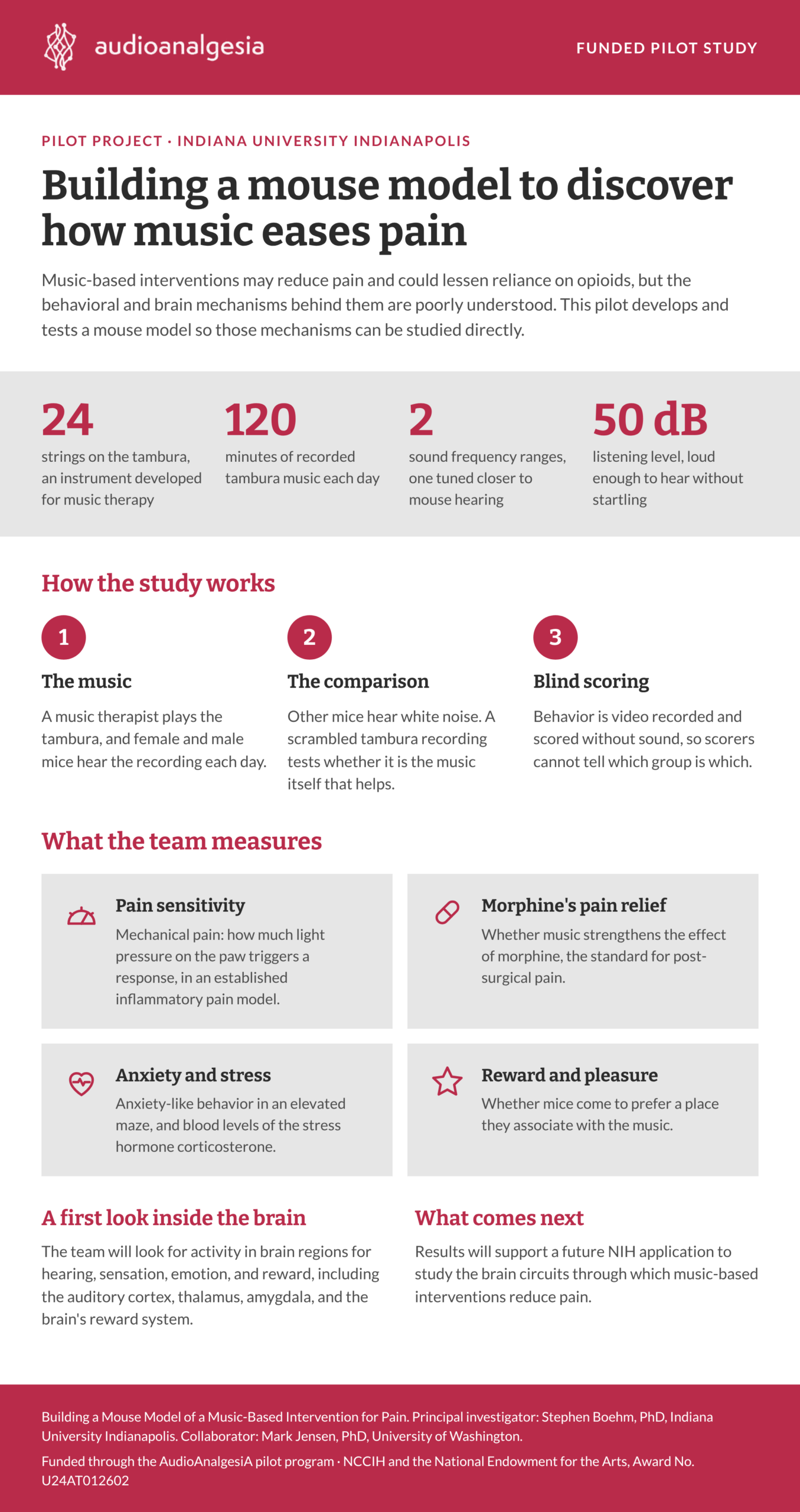
A pilot study funded through the audioanalgesia pilot program is building a mouse model to help researchers discover how music eases pain. The project is led by Stephen Boehm, PhD, at Indiana University Indianapolis, with collaborator Mark Jensen, PhD, at the University of Washington.
Music-based interventions may reduce pain and could lessen reliance on opioid medications, but the behavioral and brain mechanisms behind them are poorly understood. Animal models make it possible to study those mechanisms directly. This pilot tests whether music reduces pain sensitivity and pain-related behaviors in mice, which would make the mouse a useful model for future studies of how music acts on the brain.
The music
The study uses music from the tambura, a 24-string instrument developed for music therapy and based on the classical Indian tambura. A music therapist plays the instrument, and female and male mice hear the recording for two hours a day at a 50-decibel listening level. The team compares the tambura with white noise, and an additional comparison with a scrambled tambura recording asks whether it is the music itself that helps.
What the team measures
- Mechanical pain sensitivity: how much light pressure on the paw triggers a response, in an established inflammatory pain model
- Morphine’s pain relief, and whether music strengthens it
- Anxiety and stress, through behavior in an elevated maze and blood levels of the stress hormone corticosterone
- Reward and pleasure, by testing whether mice come to prefer a place they associate with the music
The team will also look for activity in brain regions for hearing, sensation, emotion, and reward. Results will support a future NIH application to study the brain circuits through which music-based interventions reduce pain.