audioanalgesiaaudioanalgesiaaudioanalgesiaaudioanalgesia
  • About
  • Team
  • Research
  • Pilot Funding
  • Publications
  • News
  • Join Our Network

Pilot Funding

The audioanalgesia pilot program funds small-scale, high-risk and high-reward studies focused on mechanisms and innovative measurement in music-based pain research.

Pilot projects explore integrative models of how music influences pain, from psychosocial and behavioral factors to neurophysiological and molecular ones. Each project is designed to generate preliminary data that helps new and established investigators compete for larger, definitive studies of music-based interventions and pain.
Current status

The 2025-2027 call for applications has closed. Future funding opportunities will be announced here and to network members.

Join Our Network for Updates

Funded Pilot Projects

Yale School of Nursing · Study protocol, 2026

Clinical and mechanistic responses to a music-based intervention for pain in adults with irritable bowel syndrome

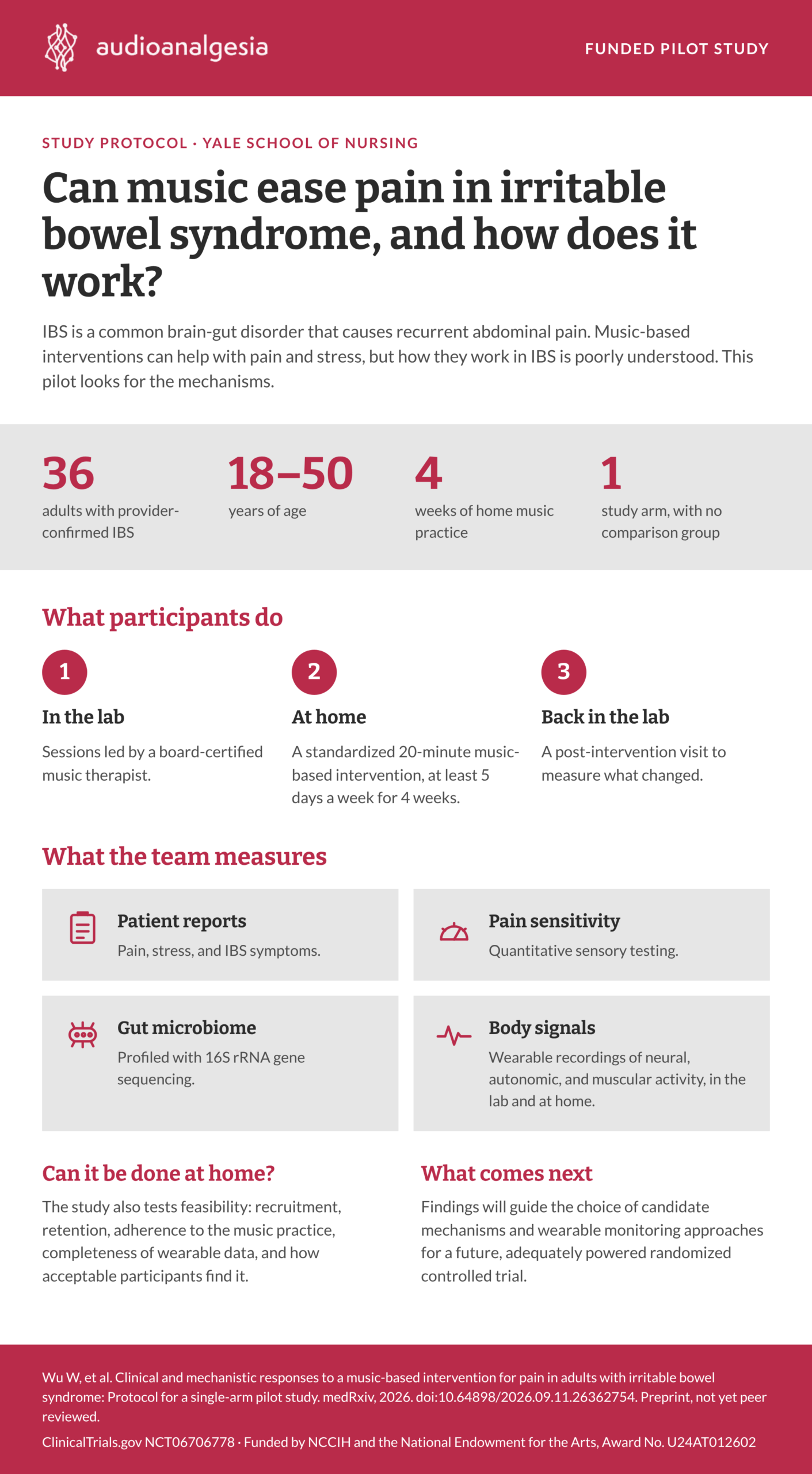
This single-arm pilot study examines how a music-based intervention affects pain in 36 adults with irritable bowel syndrome, and whether wearable sensors can track the body’s response at home as well as in the lab. Participants complete sessions with a board-certified music therapist, then four weeks of home practice.

The team measures pain, stress, and IBS symptoms; pain sensitivity; the gut microbiome; and neural, autonomic, and muscular activity. Findings will guide the design of a future randomized controlled trial.

Read the protocol (medRxiv preprint)
ClinicalTrials.gov: NCT06706778

Infographic summarizing the AudioAnalgesiA-funded pilot study of a music-based intervention for pain in adults with irritable bowel syndrome

View the full infographic

Indiana University Indianapolis · Pilot project

Building a mouse model of a music-based intervention for pain

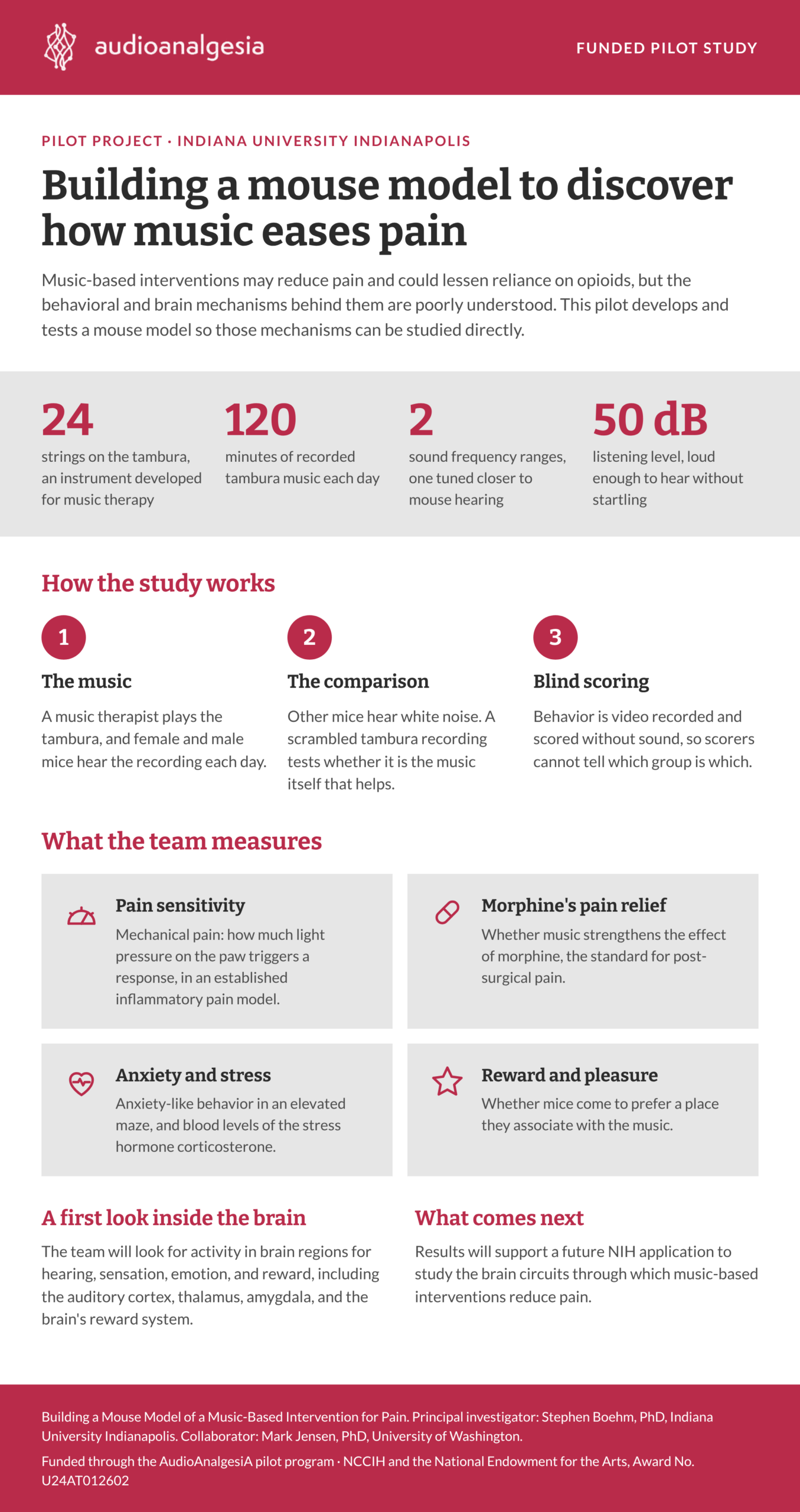
This pilot develops and tests a mouse model so the behavioral and brain mechanisms of music-based pain interventions can be studied directly. Female and male mice hear recorded music from the tambura, a 24-string instrument developed for music therapy, played by a music therapist. The team compares the music with white noise and with a scrambled tambura recording.

The team measures mechanical pain sensitivity in an established inflammatory pain model, whether music strengthens morphine’s pain relief, anxiety and stress, and whether mice come to prefer a place associated with the music. Results will support a future NIH application to study the brain circuits involved.

Principal investigator: Stephen Boehm, PhD, Indiana University Indianapolis. Collaborator: Mark Jensen, PhD, University of Washington.

Infographic summarizing the AudioAnalgesiA-funded pilot study building a mouse model of a tambura music-based intervention for pain

View the full infographic

Join Our Network

Music-Based Interventions and Pain

This project establishes a collaborative network of scientists and clinicians from various disciplines—music therapy, psychology, biomedical engineering, medicine, integrative therapies, molecular toxicology—to address major gaps in our understanding of music-based interventions (MBIs) in chronic pain. By bridging gaps in basic, applied, and clinical research, the project aims to optimize MBI research and accelerate its programs.

The efforts of this Research Network will result in new collaborations, new understandings of the mechanisms of MBIs, and new innovative technologies to measure pain outcomes. Additionally, we will carry out a pilot study program to address important gaps in knowledge related to psychosocial, behavioral, and/or neurophysiological factors related to MBIs’ influence on pain.

This project is made possible by Grant Number U24AT012602 from National Center for Complementary and Integrative Health (NCCIH) and the National Endowment for the Arts (NEA). Its contents are solely the responsibility of the authors and do not necessarily represent the official views of the NCCIH, NEA, or the National Institutes of Health.

Interested in receiving updates or joining our research network? Please let us know who you are!

    audioanalgesia © 2026 | All Rights Reserved
    • About
    • Team
    • Research
    • Pilot Funding
    • Publications
    • News
    • Join Our Network
    audioanalgesia